Thursday, June 5, 2008

Wednesday, May 14, 2008
Free Cal Tech Instruction @ Mt. SAC

Keith and Raymond had the marvelous idea to play the video of "Angular Momentum" from Cal Tech. We learned that Cal Tech had to hire "professional" women actresses to sit in the room
while the Professor gave his lecture. We were then separated in groups by: horror films. Like always Prof Mason, got excited about the topic of the day:
 Torque and Angular Momentum. Another useful tactic we could use during the celebration of learning is the 3 finger rule. I don't
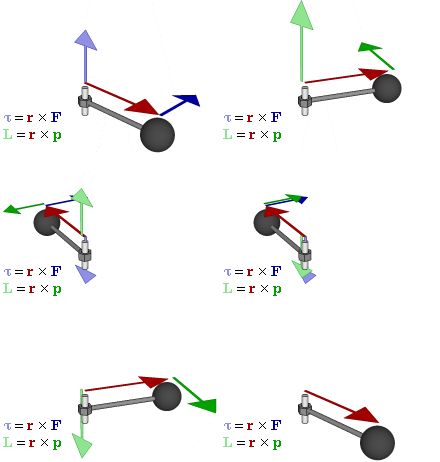 quiet remember the name, but I believe your middle finger, index, and thumb are involved. Your thumb will be pointing up or downward(y-axis), and your index finger will be point to the left or right(x axis), finally your middle finger would be point inward would would be a dot or outward which would be an x.
Consider the way Mason had explained it during the class. The bow and arrow. When the person is shooting the arrow the only thing the other person would be able to see is a dot; however, the person holding the arrow would see an x. This is a very good way to pass the celebration of learning. I expect to see those middle fingers up in the air!! as well as thumbs and index finger.
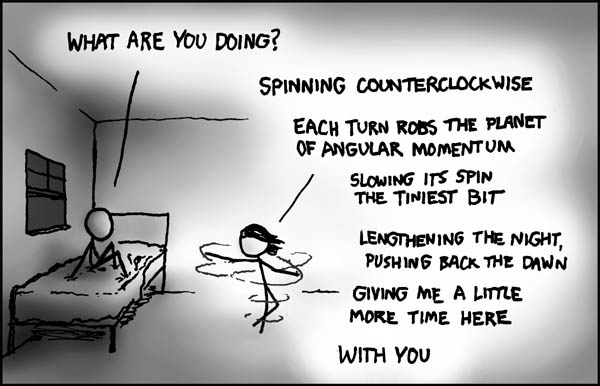 Followed by the disscussion of torque. We discussed the magnificent angular momentum. Yes folks if you ever fall in love you are able to spend more time with your loved one if you just simply spin around to rob the earth of its Angular momentum. After the discussion and the little minutes that were left from the class, Mr. Mason started to discuss the vpython project. Instead of being due this Thursday he extended the project to be due next Thursday. After careful calculations, Tong said that the measurements that Mason has given was having the object go into the earth rather then go around it. He has given the new measurements in class. I however, lost those measurements, but I do know what Mason gave us. He gave us the semi minor axis which would be b=axsqrt((e^2)-1) and the apogee which could be set as b=a(e+1).
Here are some uselinks to help you get along:
http://en.wikipedia.org/wiki/Angular_momentum
http://en.wikipedia.org/wiki/Torque
Here are some useful equations:
t=rxf
L=rxp
t=dl/dt
f=d/dt(mv)
Monday, May 12, 2008
possible future project!??
Hey, well i'm going to be the first to admit, this isn't going to be one of those quality blogs. But I just wanted to share this with the rest of the class. It's a very cheap way to make a multitouch input device, like the kind that's on the iPhone.
I came across it on youtube.com
could it be a possible future physics project?
I came across it on youtube.com
could it be a possible future physics project?
Friday, May 9, 2008
May 8th, 2008. Quiz Recap, Kepler Summary, Background on Kepler & Tycho
Quiz Recap:
- What is the moment of Inertia about a rod that is hinged at the bottom with a mass of 1.9 kg and length 0.76m.? The moment of inertia of a uniform rod about one end is 1/3 ML^2 therefore
I = (1/3)(1.9)(.76)^2
=0.37kgm^2
- What is the angular velocity of the rod after a bird with mass 0.51kg strikes the rod .25m below the top.
Since there are no external forces, momentum is conserved and Li=Lf.
Li is the angular momentum the bird has with respect to the origin of rotation and Lf is the angular momentum of the rod after the bird collides with it. Since the bird is stunned and falls directly to the ground after the collision, it has no final angular momentum.
rmv = Iw
w = rmv/ I
Where r is the distance the bird strikes from the point of rotation (0.76-0.25 = 0.51), m is the mass of the bird, v is the velocity of the bird, and I is the moment of inertia of the rod (0.37, calculated in part one).
Therefore:
w = [(0.51m((2.3 m/s)(0.51kg)]/0.37
= 1.6 rad/s
- What is the angular velocity that the rod has just before it strikes the ground.
We can use energy to solve this because initially the rod has rotational kinetic energy that was received from the collision, and it also has potential energy due to its position. In its final state the rod has no potential energy, however it has kinetic rotational energy.
Variables:
I = 0.37 kgm^2
m = 1.9 kg
h (center of mass) = L/2 = 0.76/2 = 0.38m
w (from part two) = 1.6 rad/s
w’ = ?
Therefore:
½ Iw^2 + mgh = ½ Iw’^2
½ (0.37)(1.6)^2 + (1.9)(9.8)(0.38) = (1/2)(0.37)w’^2
w’ = 6.4 rad/s
- A spherical kitten is sitting atop the rod. It is observed that when the bird strikes the rod it still falls with the same angular velocity that was calculated earlier. How is this so?
There are two assumptions:
- The kitten is weightless.
- The kitten has very little if any friction and therefore rolls off.
1st Law : Each planet moves in an elliptical orbit, with the central force body at one focus.
dA/ dt, which is equal to ½ r^2 d(theta)/dt or ½ r^2w, is known as the sector velocity. Kepler’s second law shows that at any point the sector velocity is the same. At perihelion, the point where the satellite is closest to the central force body, r is small however w is large. At aphelion, the point where the satellite is furthest from the central force body, r is large and w is small.
3rd law: The periods of planets are proportional to the 3/2 power of the major axis lengths of their orbits.
T = [2*pi*a^(3/2)]/ (G*m)^(1/2)
In a circular orbit, the semi major axis, ‘a’, is equal to the radius; therefore, in a circular orbit ‘a’ is replaced by ‘r’ in the above equation.
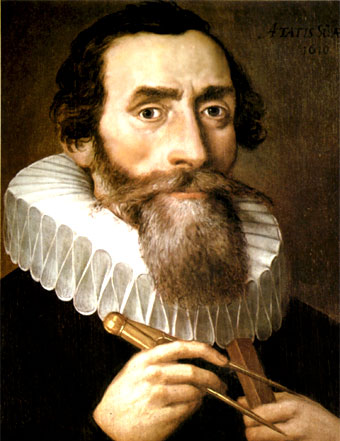
During the time that Kepler was at a university, popular belief favored a geocentric astronomy where seven planets (the Moon, Mercury, Venus, Sun, Mars, Jupiter and Saturn) moved around the Earth. However, Kepler’s astronomy teacher introduced him and a few other students to Copernicus’ heliocentric system. In the Copernican system there were six planets and the Moon was considered a different type of body. Later Kepler came to name it a satellite. After studying Brahe’s data Kepler constructed an orbit of Mars and found that it was an ellipse around the Sun which was at one focus. After additional work he extended this to the other planets. Thus his first law arose.
Geocentric(below):

In addition, Kepler discovered the correct explanation for how the human eye operates (upside down picture formed on the retina). He did the first work on optics by writing a study on the property of lenses which was inspired by Galileo’s use of the telescope. Kepler’s new design introduced a telescope using two convex lenses. This is now known as the astronomical telescope.
Some background on Brahe:

A book written by Gassendi in 1654 stated that Tycho and a nobleman Parsberg got in an argument which led to a duel in which the front of Tycho’s nose was removed. He has an artificial nose made from an alloy of gold and silver. He used to carry a small box with paste of glue that he would put on his nose. Gassendi wrote that the argument was over who was the most skilled mathematician. However this is still under debate.
Gassendi also wrote of Tycho’s tame moose. However, when the moose was sent to entertain a nobleman it drank some beer at the top of the stairs during the dinner and then fell down the stairs. This resulted in a broken leg and the moose died shortly after.
People have long thought that Tycho died from a ruptured bladder in Prage 1601, however more recent studies that have analyzed his hair have found that it is more likely he died of mercury poisoning. (http://www.nada.kth.se/~fred/tycho/index.html)

Thursday, May 8, 2008
Kepler's law notes
Kepler's Law Notes
http://docs.google.com/Doc?id=d3w6sww_85zd9hr8gc
Gravitation Questions
http://docs.google.com/Doc?id=d3w6sww_112p5k9c3dk
http://docs.google.com/Doc?id=d3w6sww_85zd9hr8gc
Gravitation Questions
http://docs.google.com/Doc?id=d3w6sww_112p5k9c3dk
Thursday, May 1, 2008
Advanced Gravitation Doc
Advanced Gravitation Word Document from Thursday's lecture.
http://download.yousendit.com/1FC87081359E837A
Refer to Page 6
credit goes to Keith for downloading the file awhile back.
Someone better volunteer to blog or else I might steal the spotlight again.
http://download.yousendit.com/1FC87081359E837A
Refer to Page 6
credit goes to Keith for downloading the file awhile back.
Someone better volunteer to blog or else I might steal the spotlight again.
Tuesday, April 29, 2008
Celebration of Knowledge Strikes Back
This will be short and isn't meant to be like the crazy blog entry I have done before.
Anybody who encounters this blog entry can comment:
Was the 2nd exam difficult? Your opinions and thoughts are welcome to the table.
Anybody who encounters this blog entry can comment:
Was the 2nd exam difficult? Your opinions and thoughts are welcome to the table.
- Energy was overlooked.
- Different CD scenario problems to study was also overlooked (most got wooped).
- My 3x5 card with equations was utterly useless.
- One problem was similar to the Geosynchronous Satellite in Mastering Physics.
- In the cart problem, I thought Brian should have been replaced with "Rutherford"(say it like Roy would) (nothing against Brian).
- My extra credit was a surprise but won't save me from my inevitable demise.
Friday, April 18, 2008
Message for Tong Li
Hey all, could you help me contact Tong,
This not Gabby; this is Ben ... need to confirm with you on JPL.
Is this your legal name: Tong Li
JPL will be on April 25th, Friday afternoon ... so you are free?
It is a high security tour: If you are U.S. citizen, you would need to show a gov't issued ID, or driver's license.
(school ID not accepted)
If you are a green card holder or legal resident or international student, you need to show your green card or Visa or Passport.
Please email me ASAP at: sps.4t.s4c@gmail.com to confirm .... or I'll have to pass down the spot...thanks...
This not Gabby; this is Ben ... need to confirm with you on JPL.
Is this your legal name: Tong Li
JPL will be on April 25th, Friday afternoon ... so you are free?
It is a high security tour: If you are U.S. citizen, you would need to show a gov't issued ID, or driver's license.
(school ID not accepted)
If you are a green card holder or legal resident or international student, you need to show your green card or Visa or Passport.
Please email me ASAP at: sps.4t.s4c@gmail.com to confirm .... or I'll have to pass down the spot...thanks...
Thursday, April 17, 2008
Someone has to write this...
Since nobody is doing the blog and I am contemplating what to do tomorrow, I'll write a quick version of what happened today.
Since Professor Mason is off in Arizona somewhere doing something Physics? related, Professor Christensen was kind enough to sub in until his 7pm Physics 2A class. After the short introduction, we began our wonderful "mini-celebration of knowledge" as it covers over the center of mass momentum.
Paraphrasing from my memory, the first question asked how far would the fisherman move if he tied a string to his cabin's door knob and pulled on a frictionless ice lake.
Since Professor Mason is off in Arizona somewhere doing something Physics? related, Professor Christensen was kind enough to sub in until his 7pm Physics 2A class. After the short introduction, we began our wonderful "mini-celebration of knowledge" as it covers over the center of mass momentum.
Paraphrasing from my memory, the first question asked how far would the fisherman move if he tied a string to his cabin's door knob and pulled on a frictionless ice lake.
- Fisherman - 80 kg
- Log Cabin - 250 kg
- Distance in between - 10 m
Using the center of mass  of a system defined as the average of their positions
  , weighted their masses mi:
Basically you take ((80*0)+(250*10)) / (250 + 80) and we should get around 7.58 m since we treat the fisherman as the origin.
The second problem had 6 parts to it involving a desperate fisherman applying his momentum force onto the cabin to save his hide.
A frustrated ice-fisherman with a mass of 80.0 kg and his 250 kg fishing cabin are sliding together across a frozen, frictionless lake towards thin ice at a speed of 1.60 m/s to the left. The cabin is ahead of the fisherman. Upon seeing the "thin ice" sign, the frustrated person pushes against the cabin for .300 seconds, giving himself a velocity of 32.0 cm/s in the opposite direction.

After the quiz, Christensen gave us an explanation of kinematics in class about rotational kinematics which uses the same kinematics that we learned in 2A. Or refer also to Mason's Rotational Kinematics notes.
Note: Tomorrow - 4/18.... sigh.
of a system defined as the average of their positions , weighted their masses mi:Basically you take ((80*0)+(250*10)) / (250 + 80) and we should get around 7.58 m since we treat the fisherman as the origin.
--------------
The second problem had 6 parts to it involving a desperate fisherman applying his momentum force onto the cabin to save his hide.
A frustrated ice-fisherman with a mass of 80.0 kg and his 250 kg fishing cabin are sliding together across a frozen, frictionless lake towards thin ice at a speed of 1.60 m/s to the left. The cabin is ahead of the fisherman. Upon seeing the "thin ice" sign, the frustrated person pushes against the cabin for .300 seconds, giving himself a velocity of 32.0 cm/s in the opposite direction.

- What is the magnitude and direction of the total momentum of the person and the cabin after they separate?
- What is the speed of the cabin after they separate?
- How much average force does the person exert on the cabin?
- How much work did the person do on himself and the cabin in order to give himself a velocity of 32.0 cm/s in the opposite direction?
- What does a fishing cabin become when it is surrounded by molecules of H2O at 10.0o C?
| mp | = 80.0 kg | (Mass of the person.) |
| mc | = 250 kg | (Mass of the cabin.) |
| vo | = 1.60 m/s | (Initial velocity of the person and cabin.) |
| vp | = .320 m/s | (Final velocity of the person.) |
| vc | = ? | (Final velocity of the cabin.) |
| tp | = .300 s | (Time the person pushes.) |
| Wp | = ? | (Work done by the person.) |
| Fave | = ? | (Average force exerted by the person.) |
Quick rundown:
1. Conservation of momentum - Final momentum must equal to Initial momentum
(250 kg+ 80 kg)(1.6 m/s) = 528 kg*m/s or N*s
2. Again, conservation of momentum
((250 kg + 80 kg)(1.6 m/s) + (80 kg)(0.320 m/s)) / 250 kg = 2.21 m/s
3. The impulse exerted on the cabin is equal to the average force multiplied by the time
(80 kg)(0.320 m/s +1.6 m/s) = 153.60 m/s
Force avg = Impulse / Time so 153.60 m/s / 0.300s = 512 N
4. Avg Work = Final KE - Initial KE or
(0.5)(250 kg)(2.21)^2 + (0.5)(80 kg)(0.320 m/s)^2 - (0.5)(250 kg + 80 kg)(1.6 m/s)^2
612.94 J + 4.096 J - 422.40 J = 194.64 J or 195 J
5. ......
Wet!

Or refer to Mason's Momentum notes.
1. Conservation of momentum - Final momentum must equal to Initial momentum
(250 kg+ 80 kg)(1.6 m/s) = 528 kg*m/s or N*s
2. Again, conservation of momentum
((250 kg + 80 kg)(1.6 m/s) + (80 kg)(0.320 m/s)) / 250 kg = 2.21 m/s
3. The impulse exerted on the cabin is equal to the average force multiplied by the time
(80 kg)(0.320 m/s +1.6 m/s) = 153.60 m/s
Force avg = Impulse / Time so 153.60 m/s / 0.300s = 512 N
4. Avg Work = Final KE - Initial KE or
(0.5)(250 kg)(2.21)^2 + (0.5)(80 kg)(0.320 m/s)^2 - (0.5)(250 kg + 80 kg)(1.6 m/s)^2
612.94 J + 4.096 J - 422.40 J = 194.64 J or 195 J
5. ......
Wet!

Or refer to Mason's Momentum notes.
Note: Tomorrow - 4/18.... sigh.
Thursday, April 10, 2008
Do I really have to do this...
Hey everyone this is Keith and i guess its finally my turn to do the post thing.
SOOOO, lets see if my memory serve my correctly as I recap on what we did today.
We started class with a quiz, and here are the questions on the quiz.
1)Calculate the velocity of planet mar. sun m=2*10^30, Earth m=6*10^24, Mars m=6.4*10^23, and Mars circle the sun once every 1.88 Earth year. The answers is about 2.4*10^4 m/s
2)Calculate the velocity of the Earth. The answer is about 3*10^4 m/s
3)Calculate the velocity a satellite need i order to stay in a constance orbit 200km above the Mars Surface. The answer was B) about 1000m/s when rounded into one significant figure.
4)Draw the graph of how the Mars and Sun effects the velocity of the satellite. the answer could be a constant or it could look like a mini sin graph.
Then my memory got a little fuzzy and i don't recall if the Newton's Cradle or fun-doh cart came next. I guess the Newton's Cradle is next.
Professor Mason showed the class a Newton's Cradle and presented a question.
 If one of the steel ball is replaced with a aluminum ball(less mass), will the system work or will it falls apart.
It turns out the system fail because the Newton"a cradle conserve both the momentum and kinetic energy. Steel ball have the mass or M and the aluminum ball have the mass of 1/3M. When the first steel ball hits the second steel ball, momentum and energy both are transfer perfectly. But when the steel ball hits the aluminum ball, 1/2mv^2 transfer to 1/2(1/3M)v^2. The equation fails and the system falls apart. So the mass have to be the same for the Newton's Cradle to work.
Professor Mason showed us a cart hitting a hard object comparing it hitting a softer object. The difference were that if it is against a hard object, force will increase very much in a very short amount of time. When the cart hits a softer object. The force is less and it is spread out in a long time interval.
Then professor showed us a sample of in an event of aircraft failure, what should you do????
-I choose to use a parachute which greatly increased the time interval before the impact.
-Edward chose the potatoe factory, which after he fall through the roof, the smashing of the potatoe will increase the time before impact.
-The next classmate(sorry i forgot his name) chose the water. But when an object hits water above 25mph, its like hitting brick wall. SO..... he didn't survive the fall. =[
-Eric chose the tree which can potentially save his life. Professor mason then told us a story about how a female flight attendant survived the fall from 30000+ft when she hits a tree and broke quite a few dozen bones but she survived.
-Chris was next and he Chose the snowy slope. Then professor mason told another story about how a British pilot during WWII survived a fall from 7000ft by aiming at a snowy hill. He only broke one bone but after he landed he was POW for 2 more years.
-Max was last and the only place left was the concrete road. Well at less its quick right?
Then professor Mason continue talking about momentum and the change in momentum. He introduce the change in momentum is Impulse.
F=ma
F=m(dv/dt)
Fdt=mdv
Then professor Mason showed how a satellite orbit goes around the moon and lands on earth, like Apollo 13 flight orbit. But the moon orbits around the Earth also, so we need to launch the rocket at a certain angle from the moon initial position and but the time the rocket reach the moon, it should the moons orbit should be in the rocket's path. Professor Mason also explain how the miscalculation of china shooting down its satellite increase the space junk. Poop is also a type of space junk. For our next project we need to design a flight plan to shoot down an orbiting satellite while avoiding all the space junk.We were assigned to our new group.
Then there was the long needed break. And the remaining group present their project while the rest of us worked on the Apollo vphython.
SOOOO, lets see if my memory serve my correctly as I recap on what we did today.
We started class with a quiz, and here are the questions on the quiz.
1)Calculate the velocity of planet mar. sun m=2*10^30, Earth m=6*10^24, Mars m=6.4*10^23, and Mars circle the sun once every 1.88 Earth year. The answers is about 2.4*10^4 m/s
2)Calculate the velocity of the Earth. The answer is about 3*10^4 m/s
3)Calculate the velocity a satellite need i order to stay in a constance orbit 200km above the Mars Surface. The answer was B) about 1000m/s when rounded into one significant figure.
4)Draw the graph of how the Mars and Sun effects the velocity of the satellite. the answer could be a constant or it could look like a mini sin graph.
Then my memory got a little fuzzy and i don't recall if the Newton's Cradle or fun-doh cart came next. I guess the Newton's Cradle is next.
Professor Mason showed the class a Newton's Cradle and presented a question.
 If one of the steel ball is replaced with a aluminum ball(less mass), will the system work or will it falls apart.
It turns out the system fail because the Newton"a cradle conserve both the momentum and kinetic energy. Steel ball have the mass or M and the aluminum ball have the mass of 1/3M. When the first steel ball hits the second steel ball, momentum and energy both are transfer perfectly. But when the steel ball hits the aluminum ball, 1/2mv^2 transfer to 1/2(1/3M)v^2. The equation fails and the system falls apart. So the mass have to be the same for the Newton's Cradle to work.
Professor Mason showed us a cart hitting a hard object comparing it hitting a softer object. The difference were that if it is against a hard object, force will increase very much in a very short amount of time. When the cart hits a softer object. The force is less and it is spread out in a long time interval.
Then professor showed us a sample of in an event of aircraft failure, what should you do????
-I choose to use a parachute which greatly increased the time interval before the impact.
-Edward chose the potatoe factory, which after he fall through the roof, the smashing of the potatoe will increase the time before impact.
-The next classmate(sorry i forgot his name) chose the water. But when an object hits water above 25mph, its like hitting brick wall. SO..... he didn't survive the fall. =[
-Eric chose the tree which can potentially save his life. Professor mason then told us a story about how a female flight attendant survived the fall from 30000+ft when she hits a tree and broke quite a few dozen bones but she survived.
-Chris was next and he Chose the snowy slope. Then professor mason told another story about how a British pilot during WWII survived a fall from 7000ft by aiming at a snowy hill. He only broke one bone but after he landed he was POW for 2 more years.
-Max was last and the only place left was the concrete road. Well at less its quick right?
Then professor Mason continue talking about momentum and the change in momentum. He introduce the change in momentum is Impulse.
F=ma
F=m(dv/dt)
Fdt=mdv
Then professor Mason showed how a satellite orbit goes around the moon and lands on earth, like Apollo 13 flight orbit. But the moon orbits around the Earth also, so we need to launch the rocket at a certain angle from the moon initial position and but the time the rocket reach the moon, it should the moons orbit should be in the rocket's path. Professor Mason also explain how the miscalculation of china shooting down its satellite increase the space junk. Poop is also a type of space junk. For our next project we need to design a flight plan to shoot down an orbiting satellite while avoiding all the space junk.We were assigned to our new group.
Then there was the long needed break. And the remaining group present their project while the rest of us worked on the Apollo vphython.
Saturday, April 5, 2008
Hi guys, I am Frank.Today, it is my turn to write up the blog
The class started at a question about curvilinear motion. From the question, we can know the velocity has vector, and it can divide in two component which is x-axis, y-axis. Then, we talked about the one of the previous test problem, and we redo it, and had a deeper analysis. We made the graph of falling object in six graph, which is acceleration on xy axis, velocity on xy axis, and position on xy axis. From the graph, we found the acceleration on x-axis is constant. Then we calculated some number which Professor Mason asked we do.
Then we did a question about crossing river. To solve this kind of problem, the connection is Time! Don't forget it.
Next topic we talked about is centripetal force. Of course, we could know the object is doing in circular motion. We did some reviews from Physics 2A.
The class started at a question about curvilinear motion. From the question, we can know the velocity has vector, and it can divide in two component which is x-axis, y-axis. Then, we talked about the one of the previous test problem, and we redo it, and had a deeper analysis. We made the graph of falling object in six graph, which is acceleration on xy axis, velocity on xy axis, and position on xy axis. From the graph, we found the acceleration on x-axis is constant. Then we calculated some number which Professor Mason asked we do.
Then we did a question about crossing river. To solve this kind of problem, the connection is Time! Don't forget it.
Next topic we talked about is centripetal force. Of course, we could know the object is doing in circular motion. We did some reviews from Physics 2A.
Fcentripetal=(mv^2)/R
When a string tie a object, and it is stayed. We could know the object has weight and Tension force. But, when it is doing in circular motion, it has centripetal force!!! At this time, the equation could be: Acceleration=(V^2)/R
T=W+F
When the object at the bottom, the Tension force will be largest.
After we finished talking about the lecture, Professor Mason give us rest of class to improve our mouse trap cart, and we also need to collect the data of the mouse trap. We used Loggerpro to record the video of cart moving by mouse trap, and calculate the acceleration, then, we need record the video of cart moving by mass, and get the another acceleration. With two acceleration, we can make a model in our Vpython.
That's all we did on April 3rd. On coming Tuesday, and Professor Mason will pass back the exam which we took on last Tuesday, and Professor Mason will pass back lab report either. The mouse trap cart also due on Tuesday, and we will test the result on that day. To get a good grade in the project, please following the form which Professor Mason post on April 3.Probably, we need show the presentation and Vpython on that day! Guys, please prepare for our first object, and get ready for our next project because Professor will give out the second project at same day.
At last,
Hope everyone get a satisfying grade on our first project.
Thanks for reading
Frank Mao
After we finished talking about the lecture, Professor Mason give us rest of class to improve our mouse trap cart, and we also need to collect the data of the mouse trap. We used Loggerpro to record the video of cart moving by mouse trap, and calculate the acceleration, then, we need record the video of cart moving by mass, and get the another acceleration. With two acceleration, we can make a model in our Vpython.
That's all we did on April 3rd. On coming Tuesday, and Professor Mason will pass back the exam which we took on last Tuesday, and Professor Mason will pass back lab report either. The mouse trap cart also due on Tuesday, and we will test the result on that day. To get a good grade in the project, please following the form which Professor Mason post on April 3.Probably, we need show the presentation and Vpython on that day! Guys, please prepare for our first object, and get ready for our next project because Professor will give out the second project at same day.
At last,
Hope everyone get a satisfying grade on our first project.
Thanks for reading
Frank Mao
Thursday, April 3, 2008
4-1-08 1st CELEBRATION OF KNOWLEDGE

EXAM TODAY!!!
On Tuesday you had the opportunity to experience your first 4A exam! 2 and 1/2 hours of pure physics joy! You wrapped your brain around conundrums about the critical angle for pushing a lawnmower, interpreting velocity graphs for a cart on at track, stacked crates on a pick up truck with a tilt bed, the many joys of a firepole which has a position dependent frictional force and finally dropping packages out of helicopters with air drag! Smiling and laughing you trooped out of class! (Only a few of you in whitecoats and straitjackets!)
NOTE: The last problem on the Mastering Physics for Tuesday is TOUGH! Plan some time for it!
Here is a copy of a rough draft of the rubric I will use for grading your projects:
Project 1 Grading Rubric
Group Members _________________- ___________________-___________________
| Objective | Score | Weight | Total |
| Was there a video of the car going out and back? | 0 1 | 2 | |
| Do the students have data from the video? | 0 1 | 2 | |
| Does the program have a visualization of the car going out and back? | 0 1 2 | 2 | |
| Is there a discussion of the mission design? | 0 1 2 | 2 | |
| Is the data from the video used to determine the motion of the car in the program? | 0 1 2 | 3 | |
| Is there a robust model for the motion of the car? | 0 1 2 | 3 | |
| Is the output from the computer model compared with actual measurements? | 0 1 2 | 3 | |
| Is there a discussion of kinematics, forces, work energy and any other physics considerations? | 0 1 2 | 2 | |
| Does the Calculated range match the measured range? >50%, 30-50%, 10-30%, <10% | 0 1 2 | 2 | |
| Are there six graphs of the kinematics quantities? | 0 1 2 | 3 | |
| Are the internal details of the computational model explained clearly? | 0 1 2 | 3 | |
| Calculated distance Out? | Measured Range Out? | % Difference | |
| Project does not run or runs minimally. There are many technical problems when viewing the project. | Project runs adequately with minor technical problems. | Project runs perfectly with no technical problems. For example, there are no error messages. | |
| Project has multiple errors in spelling and/or grammar. (Four or more errors) | Project adequately honors most rules of spelling and/or grammar. (Two or less errors) | Project honors all rules of spelling and/or grammar. | |
| Project is incomplete and contains some unfinished elements. | Project is incomplete and contains several unfinished elements. | Project is completely finished. | |
| The work is a rehash of other people's ideas. There is little evidence of new thought or inventiveness. | The project shows some evidence of originality and inventiveness. While based on an extensive collection of other people's ideas, the work extends beyond that collection to offer new insights. | The project shows significant evidence of originality and inventiveness. The majority of the content and many of the ideas are fresh, original, and inventive. | |
| Little evidence that higher level thinking skills were used in the creation of this project. | Some evidence that higher level thinking skills were used in the creation of this project. | Clear evidence that higher level thinking skills were used in the creation of this project. | |
| Some subject knowledge is evident. Some | Subject knowledge is evident in much of the project. Most information is clear, appropriate, and correct. | Subject knowledge is evident throughout the project. All information is clear, appropriate, and correct. | |
Good luck on finishing your projects for Tuesday! Remember:
Vpython Code
Google Docs presentation
WORKING CAR!!!

have fun!
Sunday, March 30, 2008
3/27/2008
Eric cannot find the link to post, so he send me what he wrote and I post for him.
3/27 Class Recap
Hi everyone,
I’m Eric Zhang, it’s my turn to write the blog this time, however, I’m not in the contributors’ list; my name out there is fake(I’ve tried many times to sign in, but it doesn’t work), so I ask Nelson (Ching Han) to use his name to post this words. Hopefully, this last post can still help to you guys to remain the stuff we learned.
1. The class started at a quiz. The problem is about cart collision. According to the force versus time graph, we had to calculate the peak acceleration, initial velocity and total distant; draw two graphs about velocity versus time and position versus time. (be careful of the direction of each vectors)
2. After the quiz, Professor gave us some information about the exam on next Tuesday.
2 problems form master physics
1 problem form Lab
2 problems made up by professor
(Included 1 kinematic, 1 work energy, 3 force)
3. Afterwards, we were introduced to the interesting topic “Superposition” since the theory was discovered the same date (March 27) on 1935. The concept of superposition helped provoke Schrödinger's conjecture, which is the combination of all the possible positions of a subatomic particle. The principle of superposition states that if the world can be in any configuration, any possible arrangement of particles or fields, and if the world could also be in another configuration, then the world can also be in a state which is a mixture of the two, where the amount of each configuration that is in the mixture is specified by a complex number. The theory has succeeded in applying to quantum computer.
4. After making group by 2^n, we worked on the first problem “Work done by a variable force”. We were remained the changing force acted by a spring, and then we calculated a non-hookian spring problem.
5. We were introduced a new theme about power (watts), Power=Changing Energy/time; Power=Work/time; Power=Force*velocity. 1hp=746watts. Furthermore, professor explained the idea of power in terms of solar output used by human.
6. Continuing our typical white board problems, we focused on power practices with air drag. There are “Air Drag on a Bicyclist” and “Constant Powers Bat-Engine”. (It is very hard to combine power and calculus together)
7. After working through the problems, we spent the last half hour on using Vpython. Similar to our project, the new introduction is about how to make a virtual car go forward then come back with acceleration.
This is the code copied from Professor.
from visual import *
wheel1 = sphere(pos=(.1,0,0), radius = 0.05,ccolor = color.red)
wheel2 = sphere(pos=(-.1,0,0), radius= 0.1, color = color.red)
body = box(pos = (0,0,0), size=(0.2,0.05,.2), color = color.green)
floor = box(pos =(0,-0.05,0), size = (5,0.01,0), color = color.blue)
scene.autoscale = 0
body.velocity = vector(1,0,0)
body.aceleration = vector(0,0,0)
dt = 0.00001
t=0
while (1==1):
rate = 100
t = t + dt
body.pos = body.pos + body.velocity * dt
body.velocity = body.velocity + body.aceleration * dt
wheel1.pos = body.pos + vector (0.1,0,0)
wheel2.pos = body.pos + vector (-0.1,0,0)
if t<0.5: aceleration =" vector(2,0,0)">0.5:
body.aceleration = vector(-2,0,)
if t>1:
body.aceleration = vector(-2,0,0)
Ok, that’s all we done on March 27, welcome everyone make comments to add whatever I missed or correct any of my mistakes.
At last,
Best wishes for Professor Masson can get well soon.
Hope everybody get a satisfying grade on the first exam.
Thanks for reading.
Eric Zhang
3/27 Class Recap
Hi everyone,
I’m Eric Zhang, it’s my turn to write the blog this time, however, I’m not in the contributors’ list; my name out there is fake(I’ve tried many times to sign in, but it doesn’t work), so I ask Nelson (Ching Han) to use his name to post this words. Hopefully, this last post can still help to you guys to remain the stuff we learned.
1. The class started at a quiz. The problem is about cart collision. According to the force versus time graph, we had to calculate the peak acceleration, initial velocity and total distant; draw two graphs about velocity versus time and position versus time. (be careful of the direction of each vectors)
2. After the quiz, Professor gave us some information about the exam on next Tuesday.
2 problems form master physics
1 problem form Lab
2 problems made up by professor
(Included 1 kinematic, 1 work energy, 3 force)
3. Afterwards, we were introduced to the interesting topic “Superposition” since the theory was discovered the same date (March 27) on 1935. The concept of superposition helped provoke Schrödinger's conjecture, which is the combination of all the possible positions of a subatomic particle. The principle of superposition states that if the world can be in any configuration, any possible arrangement of particles or fields, and if the world could also be in another configuration, then the world can also be in a state which is a mixture of the two, where the amount of each configuration that is in the mixture is specified by a complex number. The theory has succeeded in applying to quantum computer.
4. After making group by 2^n, we worked on the first problem “Work done by a variable force”. We were remained the changing force acted by a spring, and then we calculated a non-hookian spring problem.
5. We were introduced a new theme about power (watts), Power=Changing Energy/time; Power=Work/time; Power=Force*velocity. 1hp=746watts. Furthermore, professor explained the idea of power in terms of solar output used by human.
6. Continuing our typical white board problems, we focused on power practices with air drag. There are “Air Drag on a Bicyclist” and “Constant Powers Bat-Engine”. (It is very hard to combine power and calculus together)
7. After working through the problems, we spent the last half hour on using Vpython. Similar to our project, the new introduction is about how to make a virtual car go forward then come back with acceleration.
This is the code copied from Professor.
from visual import *
wheel1 = sphere(pos=(.1,0,0), radius = 0.05,ccolor = color.red)
wheel2 = sphere(pos=(-.1,0,0), radius= 0.1, color = color.red)
body = box(pos = (0,0,0), size=(0.2,0.05,.2), color = color.green)
floor = box(pos =(0,-0.05,0), size = (5,0.01,0), color = color.blue)
scene.autoscale = 0
body.velocity = vector(1,0,0)
body.aceleration = vector(0,0,0)
dt = 0.00001
t=0
while (1==1):
rate = 100
t = t + dt
body.pos = body.pos + body.velocity * dt
body.velocity = body.velocity + body.aceleration * dt
wheel1.pos = body.pos + vector (0.1,0,0)
wheel2.pos = body.pos + vector (-0.1,0,0)
if t<0.5: aceleration =" vector(2,0,0)">0.5:
body.aceleration = vector(-2,0,)
if t>1:
body.aceleration = vector(-2,0,0)
Ok, that’s all we done on March 27, welcome everyone make comments to add whatever I missed or correct any of my mistakes.
At last,
Best wishes for Professor Masson can get well soon.
Hope everybody get a satisfying grade on the first exam.
Thanks for reading.
Eric Zhang
Wednesday, March 26, 2008
3/25 Tues Class Recap
The classroom only have around 5 people around 5oclck, which is very abnormal then usual. Then the professor came in and can't wait to start the class at exactly 5:25. First we separated to groups by human parts. Ankle, Brain .... etc
The video question of the day is a swinging ball on the hang on a board with a pin stick in the middle of board. When release the ball from a certain height and it will swing to the same height to the other end too.
Later Professor start lecture on Work and Energy, and we did some interesting Tarzan question.
All the notes can be found here under the Work Notes and Energy Notes.
http://physics.mtsac.edu/4A/4ANotes.htm
After lecture, professor talks about his nerve disorder around the jaw. Surprisingly, the class dismiss early. Our homework is only the Mastering Physics and the test is schedule to be next Tuesday. As for the Out 'N Back project, it is due when professor think we are ready.
Lets wish Professor Mason's pain will get much better with the medication treatment!!
The video question of the day is a swinging ball on the hang on a board with a pin stick in the middle of board. When release the ball from a certain height and it will swing to the same height to the other end too.
Later Professor start lecture on Work and Energy, and we did some interesting Tarzan question.
All the notes can be found here under the Work Notes and Energy Notes.
http://physics.mtsac.edu/4A/4ANotes.htm
After lecture, professor talks about his nerve disorder around the jaw. Surprisingly, the class dismiss early. Our homework is only the Mastering Physics and the test is schedule to be next Tuesday. As for the Out 'N Back project, it is due when professor think we are ready.
Lets wish Professor Mason's pain will get much better with the medication treatment!!
Tuesday, March 25, 2008
Missing Class on Thursday
There was no class on Thursday. The mastering physics deadline was pushed back until Tuesday. The exam and project due date deadlines will also be pushed back to tuesday and ??? respectively.
Some of you may recall that I was uncomfortable in class on Tuesday. I went to the doctor on Friday and was diagnosed with Trigeminal Neuralgia. I am on medication for it and will visit a neurologist on Wednesday. I obviously hope to make a full recovery and minimize the disruptions to our class.
Some of you may recall that I was uncomfortable in class on Tuesday. I went to the doctor on Friday and was diagnosed with Trigeminal Neuralgia. I am on medication for it and will visit a neurologist on Wednesday. I obviously hope to make a full recovery and minimize the disruptions to our class.
Wednesday, March 19, 2008
...and people said this was easy psh....3/18/2008
We began the class with a lecture on superconductors. It was rather interesting when MMason
started to talk about computers. After that topic we started to do a bit more force problems that
required some knowledge of kinematics. I do not think MMason separated everyone into groups. I think it was pretty much where you sat down for the day. Highly odd on MMason side. Anyways, we did your typical white board equations. Keith answers why the car picture was odd in comparasion to the problem that MMason gave us. MMason introduced us to two different types of problems. One was force drag and circular motion. Again we had to do your typical white board problems and work together to get the correct answer.....sometimes. We ended the class with the prelab we had to make previous of what MMason has instructed us to write up. The lab was about determining how much friction there was between the track and cart. I THOUGHT HE SAID THERE WILL BE NO WRITE UP!!!
You do not need to write up the POST LAB for the friction lab. (I assume all of your are diligently writing up the post labs for all our labs(answering the analysis and conclusion questions)) Therefore, when I read your lab notebook, there will be only a pre-lab on friction, but no post lab.
Anyways we started to clean up and he assigned the blog to me because I never got invited.
I also shared some ideas for how the make your out and back car work. To reiterate: your car needs to out AS FAR AS POSSIBLE and then make it back as close to the initial position as possible. Your car must go at least one meter for you to PASS! Here is a link to a site that has some great ideas on how to make your project work:
Me and my big mouth. Homework was Mastering Physics 8 and a prelab write up. Make sure you study your forces for tomorrow. We have our awesome Thursday quiz.
started to talk about computers. After that topic we started to do a bit more force problems that
required some knowledge of kinematics. I do not think MMason separated everyone into groups. I think it was pretty much where you sat down for the day. Highly odd on MMason side. Anyways, we did your typical white board equations. Keith answers why the car picture was odd in comparasion to the problem that MMason gave us. MMason introduced us to two different types of problems. One was force drag and circular motion. Again we had to do your typical white board problems and work together to get the correct answer.....sometimes. We ended the class with the prelab we had to make previous of what MMason has instructed us to write up. The lab was about determining how much friction there was between the track and cart. I THOUGHT HE SAID THERE WILL BE NO WRITE UP!!!
You do not need to write up the POST LAB for the friction lab. (I assume all of your are diligently writing up the post labs for all our labs(answering the analysis and conclusion questions)) Therefore, when I read your lab notebook, there will be only a pre-lab on friction, but no post lab.
Anyways we started to clean up and he assigned the blog to me because I never got invited.
I also shared some ideas for how the make your out and back car work. To reiterate: your car needs to out AS FAR AS POSSIBLE and then make it back as close to the initial position as possible. Your car must go at least one meter for you to PASS! Here is a link to a site that has some great ideas on how to make your project work:
Me and my big mouth. Homework was Mastering Physics 8 and a prelab write up. Make sure you study your forces for tomorrow. We have our awesome Thursday quiz.
Friday, March 14, 2008
Thursday, 03/13/2008 Physics 4AG 17:25-21:05+++
Hi mates and my dearest Professor Mason,
Unfortunately, I am the one chosen to be writing the blog this time. As English is my 2nd language, please correct me if you see any grammar mistake or error. Thank you!
1) A wonderful quiz at the beginning of the class, it was about 30 mins. (Including the analysis by Professor Mason) It makes me starting to imagine about a flea that weights 100g for the rest of the night.
2)Discussion 1: A cart with a ball shooter move horizontally with a constant velocity, then shoot out a metallic ball with a constant velocity of during the movement. Will the ball fall a) back into the cart? b) fall behind of the cart? c) fall in front of the cart? The result is a); the ball will fall back into the cart. It is because the cart and the ball have the same horizontal velocity, so the distances they move are the same.
3) Discussion 2: Same situation as Discussion 1, but we used a very light plastic ball instead of the metallic ball. Same question was asked, and we got the same result. The reason is same, too. The cart and the ball have the same horizontal velocity, so the distances they move are the same.
3) Discussion 3: According to the situation above, more information was given. The cart is moving horizontally at a velocity of 1 m/s. The ball was given a velocity of 2 m/s by the ball shooter. After how long will the ball fall back into the cart? Answer was 0.4 s.
4) Discussion 4: Add acceleration to the cart in the situation above. Where will the ball fall off at? In front of the cart, behind of the cart, or into the cart? Answer was behind the car. The reason is the velocity is changing to be bigger, but the velocity of the ball in horizontal is staying constant. Therefore, in a same amount of time, the cart moves farther than the ball does.
5) Discussion 5: A box A weights 850 g was placed on the floor and with a box B weights 650 g placed on its center top. Friction between box A and B is 0.49 and 0.325 between box A and the floor.
-Draw 3 free-body diagrams for A, B and the whole system.
-Try to find the minimum force that can make the whole thing start moving. It was about 14.65 N.
-How much force do we need to apply to box A then box B will start to slide off?
-After how long will the box B fall off from the edge of box A? It was about 0.44 s.
Lab for “Force and Motion” was started at about at 20:35.
-We use video camera to measure the acceleration of a cart while pulling by a cord with heavy mass at the other end.
It was a funny Lab and it was a interesting class.
Hopefully my summary will be useful. Professor Mason, could you please correct my mistake or fill up anything that I forget to put in? Thank you very much!
Ching Han
Unfortunately, I am the one chosen to be writing the blog this time. As English is my 2nd language, please correct me if you see any grammar mistake or error. Thank you!
1) A wonderful quiz at the beginning of the class, it was about 30 mins. (Including the analysis by Professor Mason) It makes me starting to imagine about a flea that weights 100g for the rest of the night.
2)Discussion 1: A cart with a ball shooter move horizontally with a constant velocity, then shoot out a metallic ball with a constant velocity of during the movement. Will the ball fall a) back into the cart? b) fall behind of the cart? c) fall in front of the cart? The result is a); the ball will fall back into the cart. It is because the cart and the ball have the same horizontal velocity, so the distances they move are the same.
3) Discussion 2: Same situation as Discussion 1, but we used a very light plastic ball instead of the metallic ball. Same question was asked, and we got the same result. The reason is same, too. The cart and the ball have the same horizontal velocity, so the distances they move are the same.
3) Discussion 3: According to the situation above, more information was given. The cart is moving horizontally at a velocity of 1 m/s. The ball was given a velocity of 2 m/s by the ball shooter. After how long will the ball fall back into the cart? Answer was 0.4 s.
4) Discussion 4: Add acceleration to the cart in the situation above. Where will the ball fall off at? In front of the cart, behind of the cart, or into the cart? Answer was behind the car. The reason is the velocity is changing to be bigger, but the velocity of the ball in horizontal is staying constant. Therefore, in a same amount of time, the cart moves farther than the ball does.
5) Discussion 5: A box A weights 850 g was placed on the floor and with a box B weights 650 g placed on its center top. Friction between box A and B is 0.49 and 0.325 between box A and the floor.
-Draw 3 free-body diagrams for A, B and the whole system.
-Try to find the minimum force that can make the whole thing start moving. It was about 14.65 N.
-How much force do we need to apply to box A then box B will start to slide off?
-After how long will the box B fall off from the edge of box A? It was about 0.44 s.
Lab for “Force and Motion” was started at about at 20:35.
-We use video camera to measure the acceleration of a cart while pulling by a cord with heavy mass at the other end.
It was a funny Lab and it was a interesting class.
Hopefully my summary will be useful. Professor Mason, could you please correct my mistake or fill up anything that I forget to put in? Thank you very much!
Ching Han
Wednesday, March 12, 2008
Forces and Vpython Graphs
Hi Folks,
I didn't assign anyone to do the blog this time which means I am stuck doing it myself!
We started looking at Newton's first law and explored a problem with a balloon inside a large clear plastic box. Groups predicted how the direction of motion of the balloon would compare to the acceleration of the box. There were fixed results, but after performing the experiment it was discovered that the balloon moves in the direction of the acceleration since the air in the box has some inertia.
I asked each group to list all the types of forces that they could define from physics 2A. We compiled a list of 8 or so different forces.
From there we reviewed freebody diagrams, looking at a problem where a box was supported by a cable and an applied force applied normal to the cable.
Here is a link to all the forces notes for this section: http://physics.mtsac.edu/4A/4A%20Text/Forces.doc
We went through the analysis of the problem and then worked through the pumpkin problem. Finally we looked at the Pre-Lab question of how the vertical displacement of a cord depended on the distance between the points of attachment and the applied masses.
Students spent some time taking data on the vertical displacement and looked at both the small angle region and the large angle region. In the small angle region L is much larger then y so the sin (O) = tan (O) = O. This approximation lets us right down a fairly simple expression for the displacement. In the absence of the small angle approximation more algebra is required.
After working through the lab we spent the last hour talking about using Vpython for graphing.
Here is the handout I showed in class:
Controlling One or More Visual Display Windows
scene2 = display(title='Graph of position', width=600, height=200, center=(5,0,0), background=(0,1,1))
Mouse Interactions
I didn't assign anyone to do the blog this time which means I am stuck doing it myself!
We started looking at Newton's first law and explored a problem with a balloon inside a large clear plastic box. Groups predicted how the direction of motion of the balloon would compare to the acceleration of the box. There were fixed results, but after performing the experiment it was discovered that the balloon moves in the direction of the acceleration since the air in the box has some inertia.
I asked each group to list all the types of forces that they could define from physics 2A. We compiled a list of 8 or so different forces.
From there we reviewed freebody diagrams, looking at a problem where a box was supported by a cable and an applied force applied normal to the cable.
Here is a link to all the forces notes for this section: http://physics.mtsac.edu/4A/4A%20Text/Forces.doc
We went through the analysis of the problem and then worked through the pumpkin problem. Finally we looked at the Pre-Lab question of how the vertical displacement of a cord depended on the distance between the points of attachment and the applied masses.
Students spent some time taking data on the vertical displacement and looked at both the small angle region and the large angle region. In the small angle region L is much larger then y so the sin (O) = tan (O) = O. This approximation lets us right down a fairly simple expression for the displacement. In the absence of the small angle approximation more algebra is required.
After working through the lab we spent the last hour talking about using Vpython for graphing.
Here is the handout I showed in class:
Additional Features in Vpython:
Controlling One or More Visual Display Windows
Initially, there is one Visual display window named scene. Display objects do not create windows on the screen unless they are used, so if you immediately create your own display object early in your program you will not need to worry about scene. If you simply begin creating objects such as sphere they will go into scene.
display() Creates a display with the specified attributes, makes it the selected display, and returns it. For example, the following creates another Visual display window 600 by 200, with 'Graph of position' in the title bar, centered on (5,0,0) and with a background color of cyan filling the window.
scene2 = display(title='Graph of position', width=600, height=200, center=(5,0,0), background=(0,1,1))
Now we will start by adding a few additional features to your bouncing balls
program from last week. Open up your bouncing ball program from last week.
Some of the most useful commands for controlling the window in the display are as follows:
center Location at which the camera continually looks, even as the user rotates the position of the camera. If you change center, the camera moves to continue to look in the same "compass" direction toward the new center, unless you also change forward (see next attribute). Default (0,0,0).
If in the loop you set:
scene.center = ball.pos
The ball will always be in the center of the screen and the box will seem to move around it.
autocenter scene.center is continuously updated to be the center of the smallest axis-aligned box containing the scene. This means that if your program moves the entire scene, the center of that scene will continue to be centered in the window.
If in the loop you set:
scene.autocenter = 0
The scene will stop autoscaling.
Mouse Interactions
Mouse objects are obtained from the mouse attribute of a display object such as scene. For example, to obtain mouse input from the default window created by Visual, refer to scene.mouse.
Inside your loop, add the following code:
if scene.mouse.clicked:
mouseevent = scene.mouse.getclick()
sphere(pos=mouseevent.pos,color=color.red)
If the mouse is clicked, generate a mouse event and create a sphere at the position where the mouse was clicked. This will create a series of red spheres over yo
ur program.
A mouse object has a group of attributes corresponding to the current state of the mouse. It also has functions getevent() and getclick(), which return an object with similar attributes corresponding to the state of the mouse when the user last did something with the mouse buttons. If the user has not already done something with the mouse buttons, getevent() and getclick() will stop program execution until this happens.
The following are useful commands for use with the mouse.
pos The current 3D position of the mouse cursor; scene.mouse.pos. Visual always
button = None (no buttons pressed), 'left', 'right', 'middle', or 'wheel' (scroll wheel pressed on some Windows mouses). Example: scene.mouse.button == 'left' is true if the left button is currently down.
pick The nearest object in the scene which falls under the cursor, or None. At present only spheres, boxes, cylinders, and convex can be picked. The picked object is scene.mouse.pick.
Now we will see how to create graphs in Vpython:
Importing from visual.graph makes available all Visual objects plus the graph plotting module. The graph is autoscaled to display all the data in the window.
At the top of your program add the following lines:
From visual.graph import *
graph1 = gdisplay()
funct = gcurve()
This will setup a separate graph window and a function to graph your data.
Inside your loop add the code:
funct.plot(pos=(t,ball.pos.x))
This will plot your ball’s x position as a function of time on the graph you just created.
A connected curve (gcurve) is just one of several kinds of graph plotting objects. Other options are disconnected dots (gdots), vertical bars (gvbars), horizon

tal bars (ghbars), and binned data displayed as vertical bars (ghistogram)
I also asked you to write up a pre-lab on our first dynamics lab. (The cart pulled by a mass)
Sunday, March 9, 2008
Our First Quiz - 3/6/2008
The first set of Thursday quizzes was given in the beginning of class. We were given 10-15 minutes of class time to finish up until it was collected. Groups were then assigned by listing natural disasters alphabetically.
Professor Mason explained also how to set the X and Y positions in the video if the video was recorded in a slanted position. This was important because the graphs can show incorrect data plots and can ruin curve fits.
In the last 1.5 hours class time, we were to work on the basic structure for our car project with the original groups. Professor Mason demonstrated how his car performed using the mouse trap to propel it down the hallway but not back.
Near the end of the class, over half of the groups already have built a car that rolls.
- Avalanche (I think)
- Blizzard
- Cyclone
- Drought
- Earthquake
- Flood
- Gamma ray burst
- Hurricane
Professor Mason explained also how to set the X and Y positions in the video if the video was recorded in a slanted position. This was important because the graphs can show incorrect data plots and can ruin curve fits.
In the last 1.5 hours class time, we were to work on the basic structure for our car project with the original groups. Professor Mason demonstrated how his car performed using the mouse trap to propel it down the hallway but not back.
Near the end of the class, over half of the groups already have built a car that rolls.
Can the groups develop a car that moves forward and back with near zero displacement in two weeks?
Stay tuned for the next Physics 4A class...
Friday, February 29, 2008
Recap of 2/28/08 Class
I don't know if I got the right order on these.
-Prof. makes coffee
-Prof. Mason talks about Raman who won a Nobel Prize for his work on scattering light
-Students counted off into groups by sequence of prime numbers
-Groups are asked to predict which string would break in a setup of weights and string. The answer was It depends on how string is pulled. The reason is because of the laws of inertia
-Prof. Mason talked about uncertainties in answers.
-Groups asked to estimate how much everyone in the world weighs together and how many heartbeats in your lifetime. Answers were given with uncertainties.
-Groups had a review question on vectors.
-Class checked out laptops and did a tutorial on vpython. A ball was created to start out and the final product was a ball bouncing around in a box.
-Students were introduced to class lab assistant
-Prof. mason told class how he wants the lab reports and pre-labs.
-Homework was given:
Finish vpython project
HINT: ball.velocity = ball.velocity + ball.acceleration * dt
Mastering Physics
Lab Report
Pre-lab (can we get notes on these posted on the blog)
-Assigned me to do the blog (GREAT JOB ROBERT!)
-Groups were created for the first huge project "Out 'N Back"
-Prof. makes coffee
-Prof. Mason talks about Raman who won a Nobel Prize for his work on scattering light
-Students counted off into groups by sequence of prime numbers
-Groups are asked to predict which string would break in a setup of weights and string. The answer was It depends on how string is pulled. The reason is because of the laws of inertia
-Prof. Mason talked about uncertainties in answers.
Themes of the Course
In science and engineering, we make decisions based on measurements. To make these decisions, we must evaluate
•What the data tells us –are there any trends?
•How good is the data –is it consistent, repeatable, accurate?
•How certain are we of any conclusions we make?
•Does the data agree with a theoretical model?
•How do we present the results?
During the course we will cover the topics of:
•Statistics
•Probability
•Error Propagation
•Regression/Curve Fitting
•Graphing practice
Definitions
The result of an experiment is given in the form:
Best Estimate of a quantity +- Uncertainty Units
This course deals with finding 1 and 2 from your data. It is assumed that many individual measurements of quantities are available so that we can apply “statistical analysis”.
TRUE VALUE = ACTUAL VALUE of the quantity (unknown in general)
ERROR= Difference between TRUE VALUE and Best Estimate (unknown)
UNCERTAINTY= Estimate of the ERROR.
The process of obtaining the best estimate for the Error is referred to as “Error Analysis”.
Further Definitions
Types of error/uncertainty:
•Mistakes: (eg. Wiring a circuit incorrectly, reading the wrong number on a digital display, bumping a balance, etc.)
Avoid them by being careful!
•Systematic error: The way in which the measurement is made leads to a consistent skew in the values recorded. Examples:
•a voltmeter that consistently reads 1% too high;
•impurities present in the water used change its density, viscosity, conductivity, solubility, etc.
•reading a graduated cylinder downward at an angle and thus getting a smaller value than actual
Avoiding and accounting for systematic errors is the heart of experiment design and planning.
It is very important to design your calibrations in great detail and to ensure that you have as accurate a knowledge of uncertainties arising from systematic errors.
Random errors and uncertainties: Random data fluctuations
Examples include:
•a digital display can only be read with certainty to the last decimal place –the “true value” is actually somewhere in between.
•noise (whether due to fundamental reasons, power lines digital instruments, nuclear decay, etc.) causing random fluctuations in a measured signal
•the inherent roughness of surfaces means that at some point the “length” of an object varies
•the random occurrence of nuclear decay
By repeating measurements and applying statistical techniques, these uncertainties can be estimated and possibly reduced
-Groups asked to estimate how much everyone in the world weighs together and how many heartbeats in your lifetime. Answers were given with uncertainties.
-Groups had a review question on vectors.
-Class checked out laptops and did a tutorial on vpython. A ball was created to start out and the final product was a ball bouncing around in a box.
-Students were introduced to class lab assistant
-Prof. mason told class how he wants the lab reports and pre-labs.
-Homework was given:
Finish vpython project
HINT: ball.velocity = ball.velocity + ball.acceleration * dt
Mastering Physics
Lab Report
Pre-lab (can we get notes on these posted on the blog)
-Assigned me to do the blog (GREAT JOB ROBERT!)
-Groups were created for the first huge project "Out 'N Back"
Subscribe to:
Comments (Atom)