- What is the moment of Inertia about a rod that is hinged at the bottom with a mass of 1.9 kg and length 0.76m.? The moment of inertia of a uniform rod about one end is 1/3 ML^2 therefore
I = (1/3)(1.9)(.76)^2
=0.37kgm^2
- What is the angular velocity of the rod after a bird with mass 0.51kg strikes the rod .25m below the top.
Since there are no external forces, momentum is conserved and Li=Lf.
Li is the angular momentum the bird has with respect to the origin of rotation and Lf is the angular momentum of the rod after the bird collides with it. Since the bird is stunned and falls directly to the ground after the collision, it has no final angular momentum.
rmv = Iw
w = rmv/ I
Where r is the distance the bird strikes from the point of rotation (0.76-0.25 = 0.51), m is the mass of the bird, v is the velocity of the bird, and I is the moment of inertia of the rod (0.37, calculated in part one).
Therefore:
w = [(0.51m((2.3 m/s)(0.51kg)]/0.37
= 1.6 rad/s
- What is the angular velocity that the rod has just before it strikes the ground.
We can use energy to solve this because initially the rod has rotational kinetic energy that was received from the collision, and it also has potential energy due to its position. In its final state the rod has no potential energy, however it has kinetic rotational energy.
Variables:
I = 0.37 kgm^2
m = 1.9 kg
h (center of mass) = L/2 = 0.76/2 = 0.38m
w (from part two) = 1.6 rad/s
w’ = ?
Therefore:
½ Iw^2 + mgh = ½ Iw’^2
½ (0.37)(1.6)^2 + (1.9)(9.8)(0.38) = (1/2)(0.37)w’^2
w’ = 6.4 rad/s
- A spherical kitten is sitting atop the rod. It is observed that when the bird strikes the rod it still falls with the same angular velocity that was calculated earlier. How is this so?
There are two assumptions:
- The kitten is weightless.
- The kitten has very little if any friction and therefore rolls off.
1st Law : Each planet moves in an elliptical orbit, with the central force body at one focus.
dA/ dt, which is equal to ½ r^2 d(theta)/dt or ½ r^2w, is known as the sector velocity. Kepler’s second law shows that at any point the sector velocity is the same. At perihelion, the point where the satellite is closest to the central force body, r is small however w is large. At aphelion, the point where the satellite is furthest from the central force body, r is large and w is small.
3rd law: The periods of planets are proportional to the 3/2 power of the major axis lengths of their orbits.
T = [2*pi*a^(3/2)]/ (G*m)^(1/2)
In a circular orbit, the semi major axis, ‘a’, is equal to the radius; therefore, in a circular orbit ‘a’ is replaced by ‘r’ in the above equation.
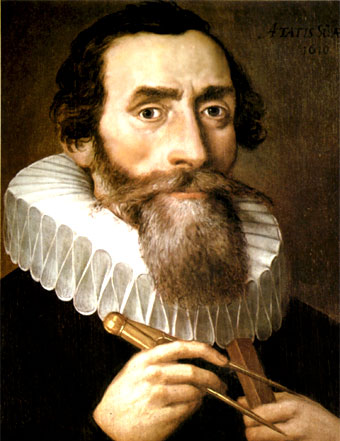
During the time that Kepler was at a university, popular belief favored a geocentric astronomy where seven planets (the Moon, Mercury, Venus, Sun, Mars, Jupiter and Saturn) moved around the Earth. However, Kepler’s astronomy teacher introduced him and a few other students to Copernicus’ heliocentric system. In the Copernican system there were six planets and the Moon was considered a different type of body. Later Kepler came to name it a satellite. After studying Brahe’s data Kepler constructed an orbit of Mars and found that it was an ellipse around the Sun which was at one focus. After additional work he extended this to the other planets. Thus his first law arose.
Geocentric(below):

In addition, Kepler discovered the correct explanation for how the human eye operates (upside down picture formed on the retina). He did the first work on optics by writing a study on the property of lenses which was inspired by Galileo’s use of the telescope. Kepler’s new design introduced a telescope using two convex lenses. This is now known as the astronomical telescope.
Some background on Brahe:

A book written by Gassendi in 1654 stated that Tycho and a nobleman Parsberg got in an argument which led to a duel in which the front of Tycho’s nose was removed. He has an artificial nose made from an alloy of gold and silver. He used to carry a small box with paste of glue that he would put on his nose. Gassendi wrote that the argument was over who was the most skilled mathematician. However this is still under debate.
Gassendi also wrote of Tycho’s tame moose. However, when the moose was sent to entertain a nobleman it drank some beer at the top of the stairs during the dinner and then fell down the stairs. This resulted in a broken leg and the moose died shortly after.
People have long thought that Tycho died from a ruptured bladder in Prage 1601, however more recent studies that have analyzed his hair have found that it is more likely he died of mercury poisoning. (http://www.nada.kth.se/~fred/tycho/index.html)


1 comment:
i enjoyed this class
Post a Comment