Thursday, June 5, 2008

Wednesday, May 14, 2008
Free Cal Tech Instruction @ Mt. SAC

Keith and Raymond had the marvelous idea to play the video of "Angular Momentum" from Cal Tech. We learned that Cal Tech had to hire "professional" women actresses to sit in the room
while the Professor gave his lecture. We were then separated in groups by: horror films. Like always Prof Mason, got excited about the topic of the day:
 Torque and Angular Momentum. Another useful tactic we could use during the celebration of learning is the 3 finger rule. I don't
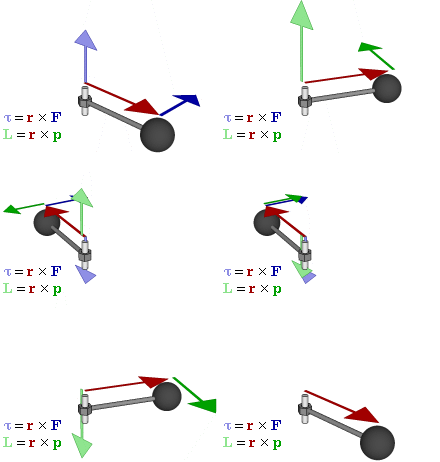 quiet remember the name, but I believe your middle finger, index, and thumb are involved. Your thumb will be pointing up or downward(y-axis), and your index finger will be point to the left or right(x axis), finally your middle finger would be point inward would would be a dot or outward which would be an x.
Consider the way Mason had explained it during the class. The bow and arrow. When the person is shooting the arrow the only thing the other person would be able to see is a dot; however, the person holding the arrow would see an x. This is a very good way to pass the celebration of learning. I expect to see those middle fingers up in the air!! as well as thumbs and index finger.
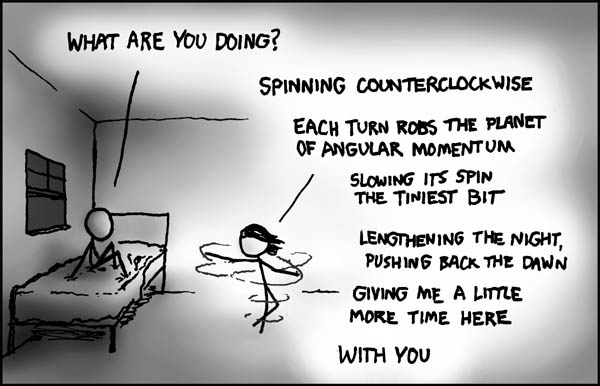 Followed by the disscussion of torque. We discussed the magnificent angular momentum. Yes folks if you ever fall in love you are able to spend more time with your loved one if you just simply spin around to rob the earth of its Angular momentum. After the discussion and the little minutes that were left from the class, Mr. Mason started to discuss the vpython project. Instead of being due this Thursday he extended the project to be due next Thursday. After careful calculations, Tong said that the measurements that Mason has given was having the object go into the earth rather then go around it. He has given the new measurements in class. I however, lost those measurements, but I do know what Mason gave us. He gave us the semi minor axis which would be b=axsqrt((e^2)-1) and the apogee which could be set as b=a(e+1).
Here are some uselinks to help you get along:
http://en.wikipedia.org/wiki/Angular_momentum
http://en.wikipedia.org/wiki/Torque
Here are some useful equations:
t=rxf
L=rxp
t=dl/dt
f=d/dt(mv)
Monday, May 12, 2008
possible future project!??
Hey, well i'm going to be the first to admit, this isn't going to be one of those quality blogs. But I just wanted to share this with the rest of the class. It's a very cheap way to make a multitouch input device, like the kind that's on the iPhone.
I came across it on youtube.com
could it be a possible future physics project?
I came across it on youtube.com
could it be a possible future physics project?
Friday, May 9, 2008
May 8th, 2008. Quiz Recap, Kepler Summary, Background on Kepler & Tycho
Quiz Recap:
- What is the moment of Inertia about a rod that is hinged at the bottom with a mass of 1.9 kg and length 0.76m.? The moment of inertia of a uniform rod about one end is 1/3 ML^2 therefore
I = (1/3)(1.9)(.76)^2
=0.37kgm^2
- What is the angular velocity of the rod after a bird with mass 0.51kg strikes the rod .25m below the top.
Since there are no external forces, momentum is conserved and Li=Lf.
Li is the angular momentum the bird has with respect to the origin of rotation and Lf is the angular momentum of the rod after the bird collides with it. Since the bird is stunned and falls directly to the ground after the collision, it has no final angular momentum.
rmv = Iw
w = rmv/ I
Where r is the distance the bird strikes from the point of rotation (0.76-0.25 = 0.51), m is the mass of the bird, v is the velocity of the bird, and I is the moment of inertia of the rod (0.37, calculated in part one).
Therefore:
w = [(0.51m((2.3 m/s)(0.51kg)]/0.37
= 1.6 rad/s
- What is the angular velocity that the rod has just before it strikes the ground.
We can use energy to solve this because initially the rod has rotational kinetic energy that was received from the collision, and it also has potential energy due to its position. In its final state the rod has no potential energy, however it has kinetic rotational energy.
Variables:
I = 0.37 kgm^2
m = 1.9 kg
h (center of mass) = L/2 = 0.76/2 = 0.38m
w (from part two) = 1.6 rad/s
w’ = ?
Therefore:
½ Iw^2 + mgh = ½ Iw’^2
½ (0.37)(1.6)^2 + (1.9)(9.8)(0.38) = (1/2)(0.37)w’^2
w’ = 6.4 rad/s
- A spherical kitten is sitting atop the rod. It is observed that when the bird strikes the rod it still falls with the same angular velocity that was calculated earlier. How is this so?
There are two assumptions:
- The kitten is weightless.
- The kitten has very little if any friction and therefore rolls off.
1st Law : Each planet moves in an elliptical orbit, with the central force body at one focus.
dA/ dt, which is equal to ½ r^2 d(theta)/dt or ½ r^2w, is known as the sector velocity. Kepler’s second law shows that at any point the sector velocity is the same. At perihelion, the point where the satellite is closest to the central force body, r is small however w is large. At aphelion, the point where the satellite is furthest from the central force body, r is large and w is small.
3rd law: The periods of planets are proportional to the 3/2 power of the major axis lengths of their orbits.
T = [2*pi*a^(3/2)]/ (G*m)^(1/2)
In a circular orbit, the semi major axis, ‘a’, is equal to the radius; therefore, in a circular orbit ‘a’ is replaced by ‘r’ in the above equation.
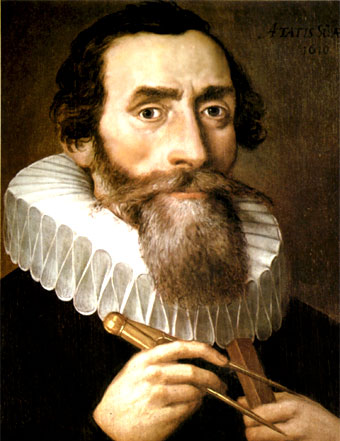
During the time that Kepler was at a university, popular belief favored a geocentric astronomy where seven planets (the Moon, Mercury, Venus, Sun, Mars, Jupiter and Saturn) moved around the Earth. However, Kepler’s astronomy teacher introduced him and a few other students to Copernicus’ heliocentric system. In the Copernican system there were six planets and the Moon was considered a different type of body. Later Kepler came to name it a satellite. After studying Brahe’s data Kepler constructed an orbit of Mars and found that it was an ellipse around the Sun which was at one focus. After additional work he extended this to the other planets. Thus his first law arose.
Geocentric(below):

In addition, Kepler discovered the correct explanation for how the human eye operates (upside down picture formed on the retina). He did the first work on optics by writing a study on the property of lenses which was inspired by Galileo’s use of the telescope. Kepler’s new design introduced a telescope using two convex lenses. This is now known as the astronomical telescope.
Some background on Brahe:

A book written by Gassendi in 1654 stated that Tycho and a nobleman Parsberg got in an argument which led to a duel in which the front of Tycho’s nose was removed. He has an artificial nose made from an alloy of gold and silver. He used to carry a small box with paste of glue that he would put on his nose. Gassendi wrote that the argument was over who was the most skilled mathematician. However this is still under debate.
Gassendi also wrote of Tycho’s tame moose. However, when the moose was sent to entertain a nobleman it drank some beer at the top of the stairs during the dinner and then fell down the stairs. This resulted in a broken leg and the moose died shortly after.
People have long thought that Tycho died from a ruptured bladder in Prage 1601, however more recent studies that have analyzed his hair have found that it is more likely he died of mercury poisoning. (http://www.nada.kth.se/~fred/tycho/index.html)

Thursday, May 8, 2008
Kepler's law notes
Kepler's Law Notes
http://docs.google.com/Doc?id=d3w6sww_85zd9hr8gc
Gravitation Questions
http://docs.google.com/Doc?id=d3w6sww_112p5k9c3dk
http://docs.google.com/Doc?id=d3w6sww_85zd9hr8gc
Gravitation Questions
http://docs.google.com/Doc?id=d3w6sww_112p5k9c3dk
Thursday, May 1, 2008
Advanced Gravitation Doc
Advanced Gravitation Word Document from Thursday's lecture.
http://download.yousendit.com/1FC87081359E837A
Refer to Page 6
credit goes to Keith for downloading the file awhile back.
Someone better volunteer to blog or else I might steal the spotlight again.
http://download.yousendit.com/1FC87081359E837A
Refer to Page 6
credit goes to Keith for downloading the file awhile back.
Someone better volunteer to blog or else I might steal the spotlight again.
Subscribe to:
Comments (Atom)